
Smart IoT Sensors for Facilities Live Monitoring, Alerting & Displays
Smart sensors monitoring environmental factors such as temperature, humidity, motion, leaks and location in real-time. Catch abnormalities before they become damage.
Temperatures • Humidity • Leaks • Movement • Location
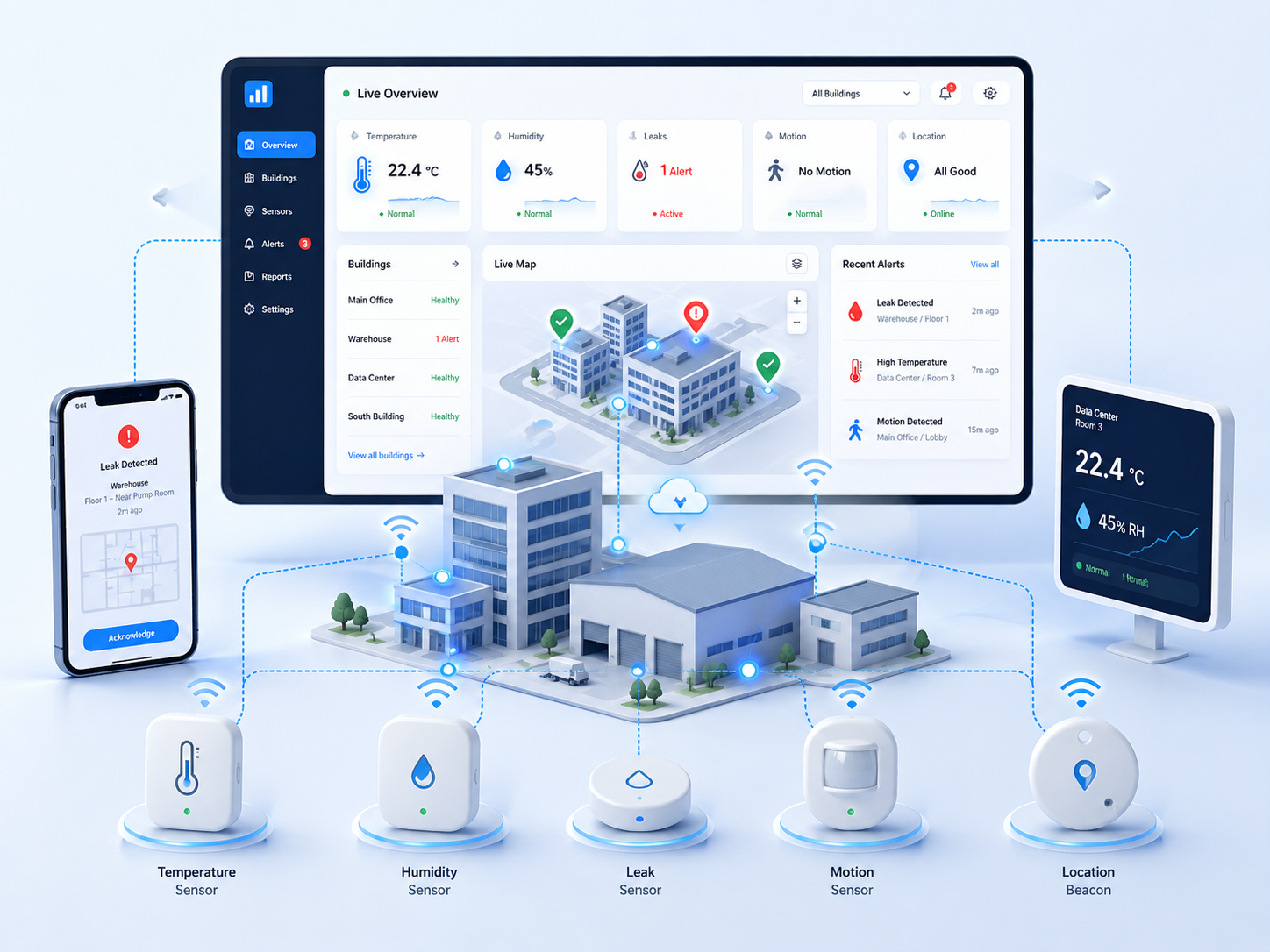
Live Monitoring, Alerting & Displays Across Every Building You Manage
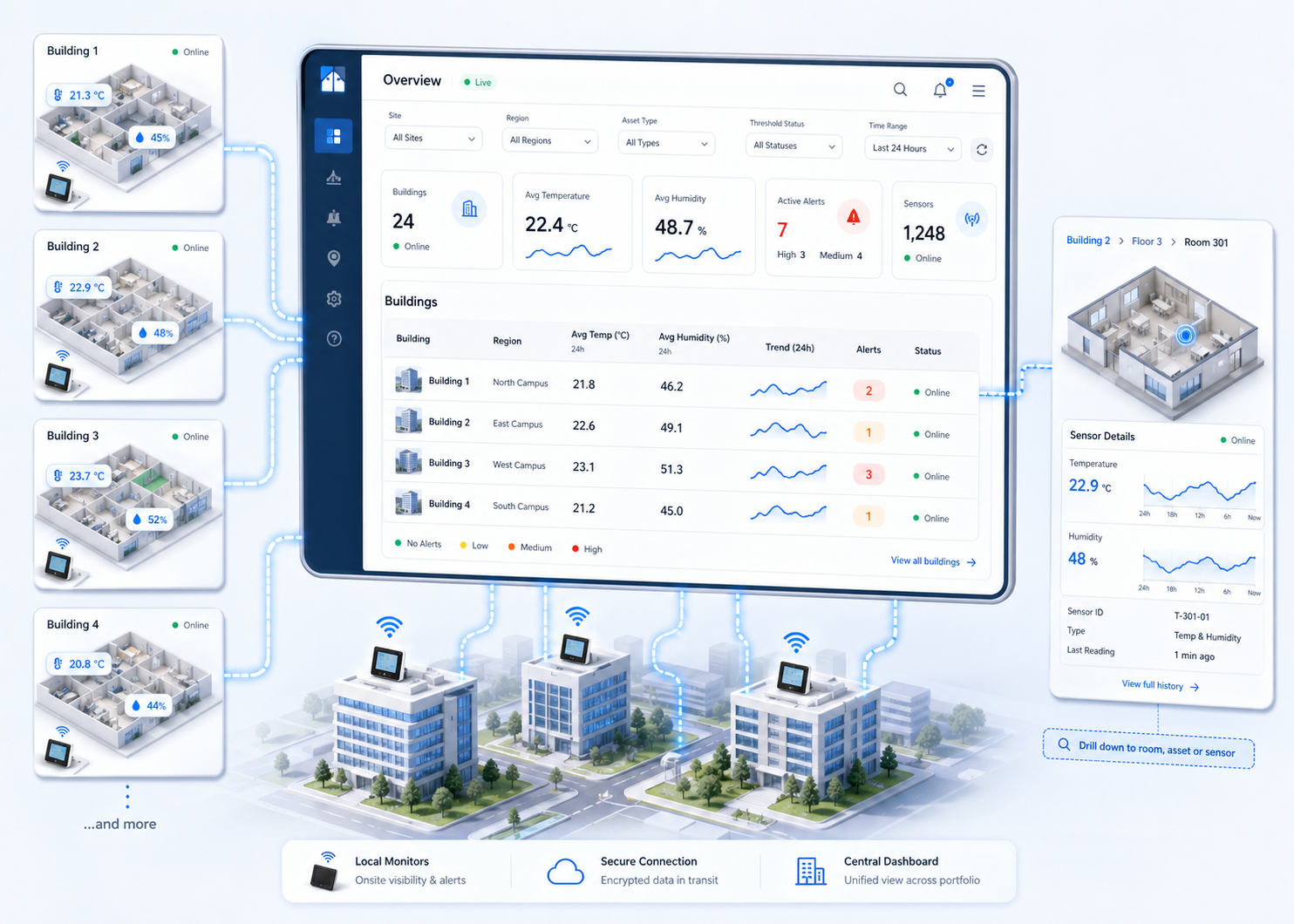
Live Central Dashboard for Every Building
- One screen rolls Building 1, Building 2, Building 3 and beyond into a single live view, no jumping between BMS portals or spreadsheets
- Current readings sit alongside average temperature and average humidity over time, so trends and drift are obvious before they become incidents
- Drill into any room, asset or sensor to investigate, every reading is timestamped and queryable
- Filter by site, region, asset type or threshold status so the operations lead sees what matters today, not the entire estate at once
- Local monitors inside each building keep onsite staff informed while the central dashboard keeps the office in the loop
From sensor to local monitor to building roll-up to central dashboard , the same data, four useful zoom levels.
SCHEDULE A DEMO
Alerting the Abnormalities, in Real-Time
- Real-time alerts on text, email and WhatsApp triggered the moment a sensor breaches a defined threshold
- Set thresholds per sensor, per asset and per site, a fridge at -4°C plays by different rules to a plant room at 33°C
- Route alerts to the right people, cold-room alarms go to the food team, leak warnings go straight to maintenance
- Escalation rules promote unacknowledged alerts up the chain so nothing sits silently in someone's inbox
- Every alert is logged with reading, timestamp and recipient , defensible evidence if anything is ever questioned
Catch a leaking pipe, a warming freezer or a triggered motion sensor within seconds, not after the damage shows up.
Watch Smart Alerts in Action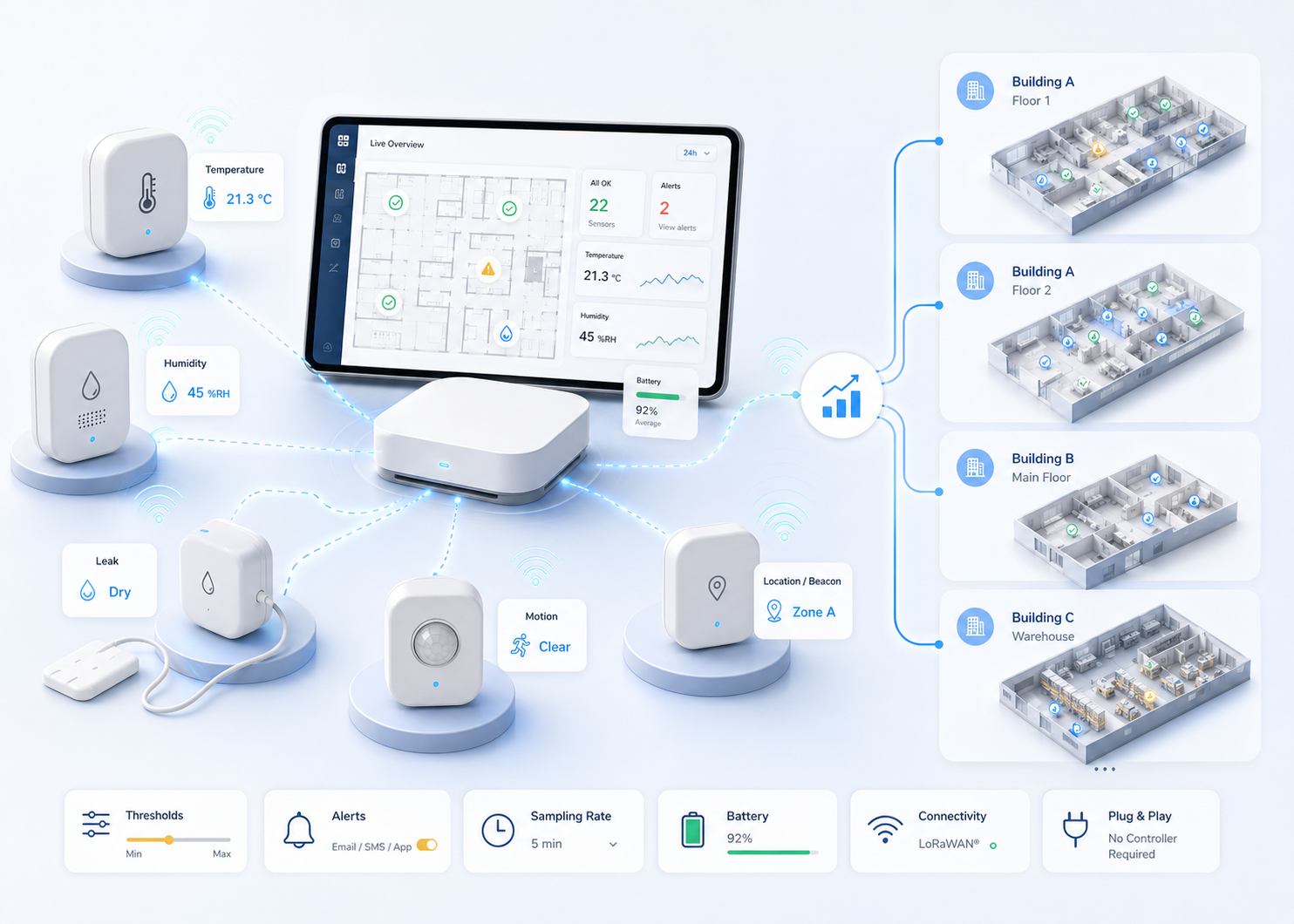
Scalable & Customisable Sensor Range
- Diverse range of sensors that work together or independently, mix temperature, humidity, leak, motion and location across the same site
- The system is scalable to increase with demand, add a new building, a new floor or a new asset class without re-engineering
- Customisable for specific requirements, change thresholds, sampling rates and alert criteria per sensor as your operation evolves
- Plug-and-play deployment to local monitors, no proprietary lock-in, no controller-per-sensor mess
- Long battery life and reliable wireless coverage designed for plant rooms, cold rooms, ceiling voids and outbuildings
Start with one building and a handful of fridges, scale to a portfolio of sites without changing the platform underneath.
Get Real-Time Demo Today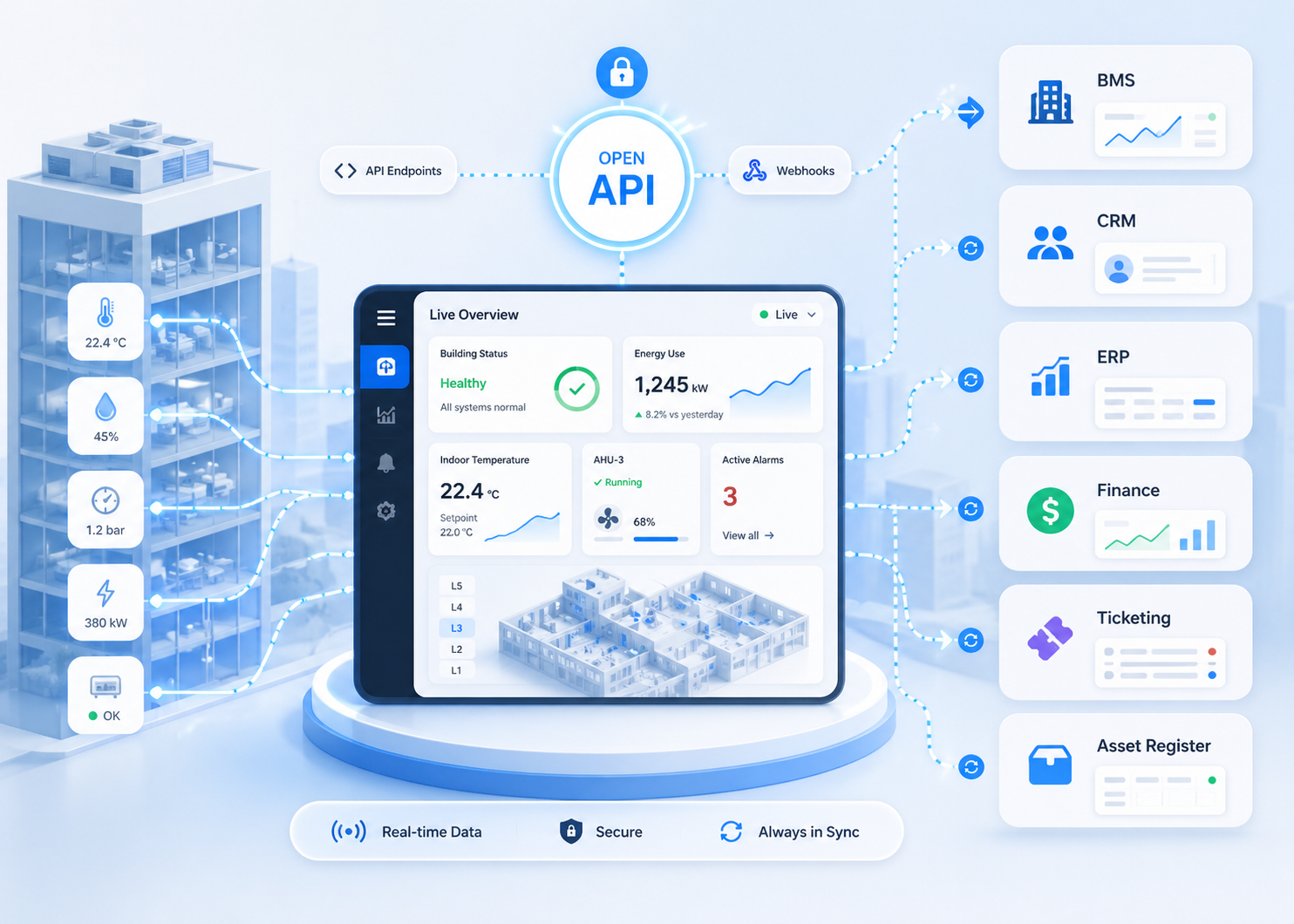
Open Integration APIs to Your Existing BMS
- Works with existing Building Management Systems (BMS), no rip-and-replace required
- Secure, real-time APIs available to connect to all leading CRM and ERP systems
- Push live readings into the tools your office already uses, dashboards, ticketing, asset registers, finance
- Webhooks for incident creation, so a leak alert opens a job in your maintenance system automatically
- Permissioned API access per integration so each downstream system gets only the readings it needs
Layer live monitoring on top of the building stack you already run , no parallel system for the team to learn.
Watch Smart IoT Sensors in Action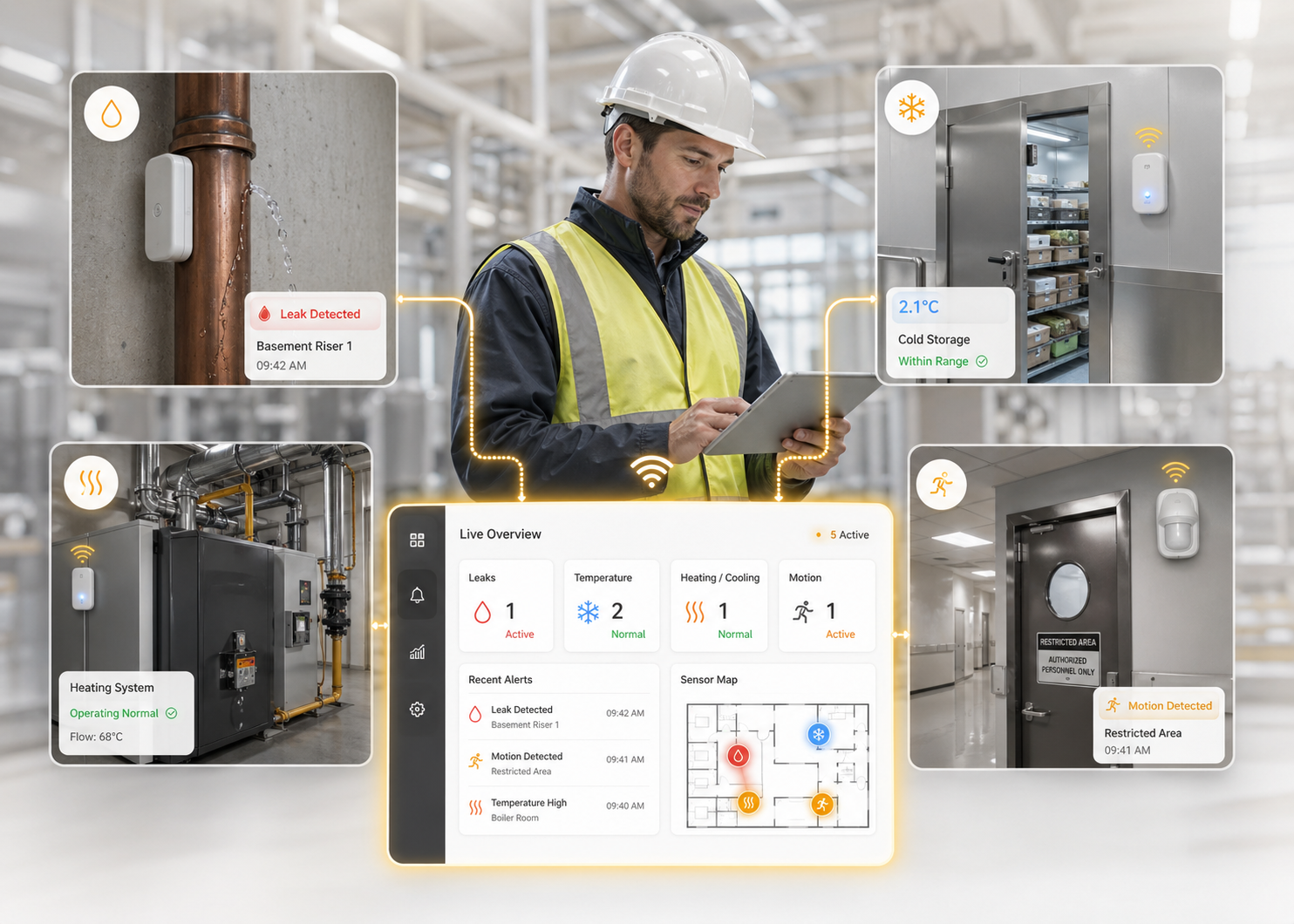
Prevent Damage Across Every Use Case
- Smart IoT sensors for monitoring leaks, heating, cooling, movement and more , recording and notifying abnormalities to staff in real-time
- Cold storage and food production: keep fridges and freezers within tolerance, with a full evidence trail for food safety audits
- Plumbing and risers: catch the slow leak before the ceiling stains and the insurance claim opens
- Plant rooms and boilers: spot a heating system drifting out of range before it fails on the coldest morning of the year
- Restricted areas: motion sensors flag access in spaces that should be empty, with a timestamped log to back it up
"IFFCO is one of the Middle East's biggest food companies. IFFCO are already using our food sensor technology."
Request Smart Sensors Demo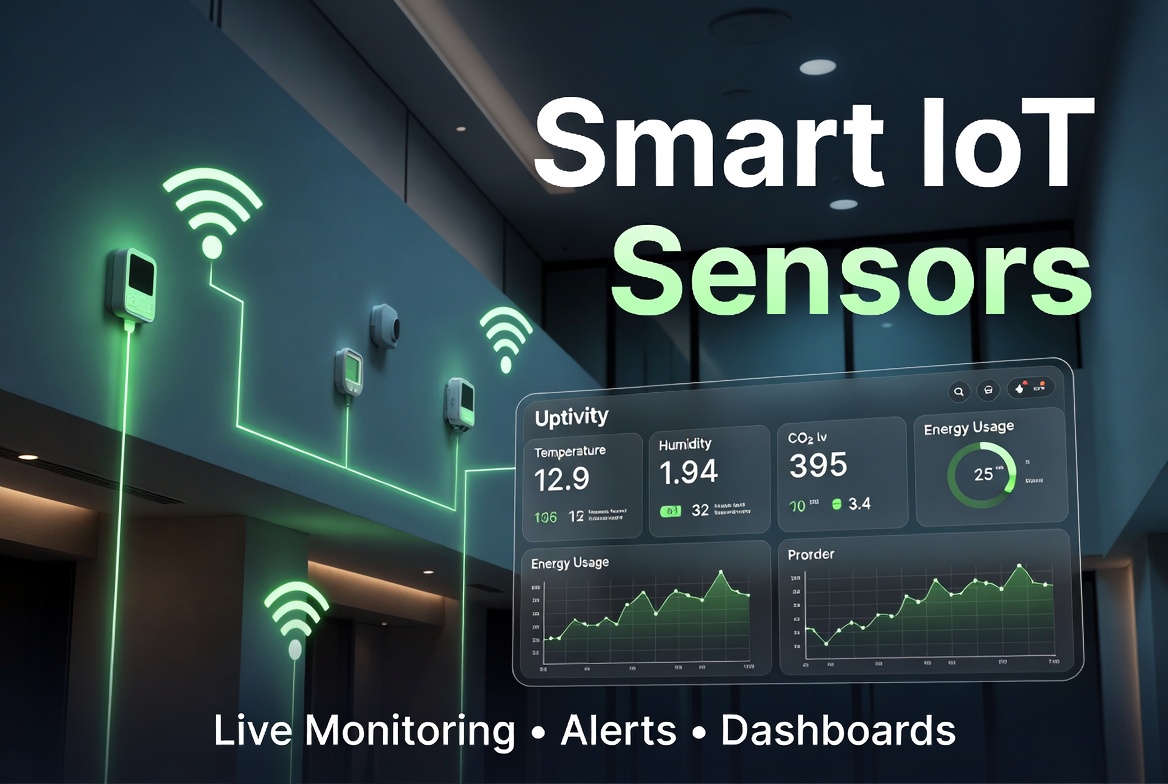
What's Inside the Platform

Live Central Dashboard
Current readings, average temperature, average humidity and trend charts for every site, rolled up into one screen for the operations lead and drillable down to each individual sensor.

SMS, Email & WhatsApp Alerts
Real-time alerts triggered on user-defined criteria. Set the threshold, set the recipient, and a leak, a warming freezer or a triggered motion sensor reaches the right person within seconds.

Open APIs & BMS Integration
Secure, real-time APIs that connect to your existing Building Management System, plus all leading CRM and ERP platforms. No rip-and-replace, no parallel system for the team to learn.

Plug-and-Play Sensor Range
Diverse range of temperature, humidity, leak, motion and location sensors that work together or independently. Add a sensor, add a building , the platform scales without re-engineering.

Local Monitors Per Building
An at-a-glance display inside each building shows live values, 21°C / 55%, a leak warning, motion status, freezer at -4°C. Onsite staff see what's happening without logging into anything.

Historical Trends & Reports
Every reading is timestamped and queryable. Pull historical trend reports per sensor, per site or per period for audits, insurance evidence and post-incident reviews.
Live Monitoring for Every Type of Site
Already trusted by operators across food, facilities, manufacturing and the public sector , including IFFCO, one of the Middle East's biggest food companies.

Commercial Buildings
Offices, retail units, business parks and mixed-use developments. Live temperature, humidity and leak monitoring across every floor, with alerts to the facilities team the moment anything drifts out of range.

Residential Buildings
High-rise blocks, HMOs and managed housing schemes. Catch leaks in risers and communal areas early, monitor plant room conditions, and keep evidence of safe environments for residents and insurers.

Cold Storage & Food Production
Fridges, freezers and production environments held within tolerance with a full audit trail for food safety. The same technology IFFCO uses to monitor its food operations across the Middle East.

Manufacturing & Industrial
Plant rooms, production lines and warehouses kept under live observation. Catch overheating equipment, leaking pipework and out-of-hours motion before it turns into downtime or damage.

Hospitals & Healthcare
Critical environments , drug fridges, lab freezers, server rooms , monitored continuously with alerts to estates teams. Defensible evidence of conditions whenever auditors or regulators ask.

Schools & Universities
Multi-block campuses with kitchens, labs, plant rooms and student housing. One central dashboard for the estates team, local monitors per building, and instant alerts when something needs attention.
Try Smart IoT Sensors
Live Building Monitoring, Simplified
Book a call with an expert
Frequently asked questions
This gives managers a clear view of what is happening across different rooms, assets or sites. If a reading moves outside the safe range, the system can alert the right person or department, helping the business act before the issue becomes expensive.
For example, the temperature sensor demo shows live fridge and freezer readings, battery status, historical temperature records and alert triggers when readings go above or below set limits.
If the sensor detects that the temperature is too high or too low, the system can send a notification to the relevant person or department. This helps teams respond early instead of discovering the problem hours later when stock, equipment or compliance records may already be affected.
The demo explains that users can set parameters and triggers so alerts are sent when a fridge or freezer temperature goes outside the required range.
This reduces the risk of missed checks, unreadable records, late entries or staff filling in logs after the event. It also gives the business a stronger evidence trail because the readings are captured by the sensor and stored in the system.
In the demo, the sensor records temperature history and allows users to view readings later, including when the temperature changed and what happened over time.
This means the business can act while there is still time to save the stock. For example, if a freezer door is left open, a power issue occurs, or the unit starts failing, the sensor can detect the temperature change and trigger an alert.
The transcript explains that the sensor can be left inside a fridge or freezer to capture data, even when no one is nearby, and the history can be checked later.
This is especially useful in buildings where leaks are not always visible straight away. A slow leak over a weekend can damage floors, ceilings, stock, electrical equipment and tenant spaces before anyone notices.
By using leak detection as part of a wider smart monitoring setup, facilities teams can move from “finding the damage” to “catching the problem early”.
This is important because a dashboard alone is not enough. If nobody is looking at it, the issue can still be missed. Automated alerts make sure the right people know when something needs attention.
The sensor demo shows how triggers can be enabled, with conditions such as temperature above or temperature below, and notifications can be sent when the sensor reading falls outside the expected range.
This is especially important outside normal working hours. Many serious problems happen overnight or at weekends, such as freezer failures, leaks, overheating equipment or abnormal environmental conditions.
The system can help businesses create a clearer response process: the sensor detects the issue, the platform records the reading, and the relevant people are notified.
The sensors collect data such as temperature, humidity, leaks, motion or equipment-related conditions and make it available in the system. This gives teams visibility even when nobody is physically present.
In the temperature sensor demo, the device can be left inside a fridge or freezer to capture data, and users can come back later to view the history.
For example, instead of relying on a paper log that may be incomplete or manually updated, the business can show sensor-backed readings over time.
The demo explains that the sensor stores temperature records, and a QR code can allow health and safety teams or contractors to view the temperature history for a specific fridge or freezer if the business chooses to allow that.
This type of record can be useful for compliance checks, food safety audits, internal investigations and insurance questions after a failure, leak or stock loss event.
In the demo, the sensor history graph shows how temperature changed over the last 12 hours, helping users see when a problem happened and whether it may have been caused by something like a power issue.
Instead of waiting for equipment to fail, the facilities team can investigate when the sensor data first shows something unusual. This helps reduce emergency callouts, downtime and damage.
The value is not just in collecting data. The value is in using the data to make earlier decisions: check the room, inspect the equipment, repair the issue, or create a work order before the failure becomes serious.
Smart IoT Sensors support condition-based maintenance by tracking real-world conditions such as temperature, humidity, leaks and equipment status. If readings start moving outside normal patterns, the maintenance team can investigate before the asset fails.
For example, if a plant room regularly overheats at certain times, or a freezer temperature slowly becomes less stable, the data helps the team act based on evidence instead of guesswork.
Smart humidity monitoring helps teams see when conditions are becoming risky before mould, condensation or stock damage appears. Alerts can also be set so the team knows when humidity goes beyond an acceptable range.
This helps businesses protect buildings, equipment, stored goods and compliance standards without relying only on visual checks.
For example, a sensor can be mounted inside a fridge, freezer, storage box, pallet area or equipment space. The demo shows that the sensor is small, battery-powered and can be mounted where monitoring is needed.
This is useful for locations that are out of sight, hard to reach or only checked occasionally. The system helps teams find out what is happening before a problem becomes visible.
Live readings help staff see what needs attention now. Historical trends help managers understand recurring problems, temperature changes, equipment performance and patterns that may not be obvious from a single reading.
In the demo, the app shows live temperature, battery level and a graph of historical temperature data for the selected sensor.
Smart IoT Sensors allow users to define variables, limits and trigger conditions. If a reading goes above or below the selected threshold, the system can notify the relevant person or department.
The demo shows that users can set high and low temperature limits, enable triggers, and define conditions such as “temperature above” or “temperature below”.
By reviewing trends over time, managers can see whether a problem is a one-off incident or part of a recurring issue. This helps the business make better maintenance decisions.
The temperature sensor demo shows historical graph data, which helps users see when temperature changed and how readings moved over time.
This is useful because it turns sensor data into work that can be tracked. Instead of someone seeing an alert and then manually reporting the issue, the alert can become part of the maintenance workflow.
For businesses using systems like MaintainPad, this can connect environmental monitoring with repairs, work orders, asset history and compliance records.
The system can record readings, show history and send alerts when something moves outside safe limits. This means the business does not have to wait until someone physically discovers the issue.
In the demo, the presenter explains that the sensor can be left in a fridge or freezer to capture data, and users can return later to review the history.
It also helps with reporting because sensor readings and history can be stored digitally. This makes it easier to support audits, compliance checks, health and safety reviews, insurance questions and internal investigations.
For businesses that currently rely on manual checks, paper logs or staff noticing problems by chance, Smart IoT Sensors provide a clearer way to protect assets, reduce downtime and make decisions using real data.